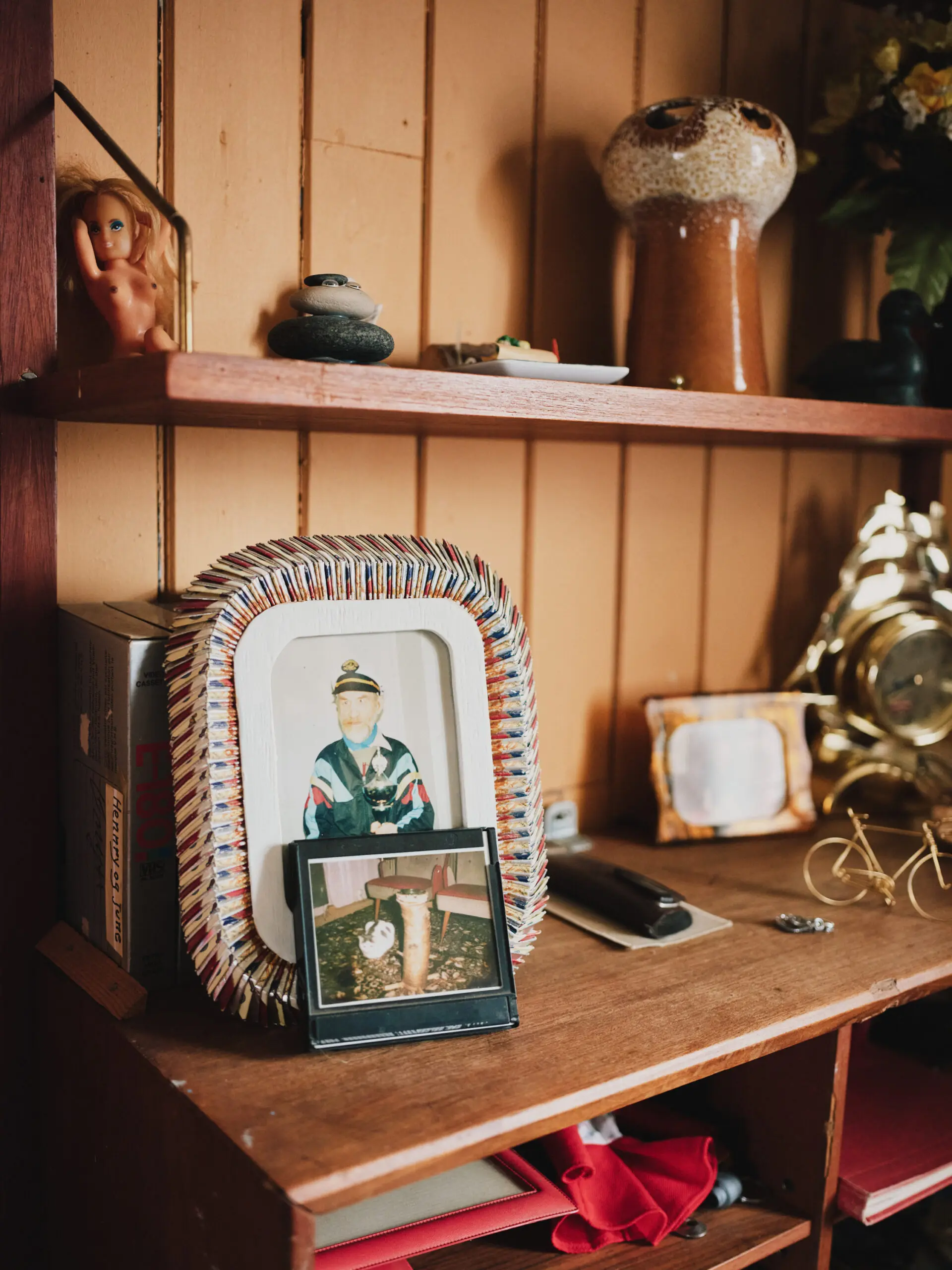
Ásgeir Jón Emilsson (1931–1999) or Geiri as he was known, left behind a precious legacy. His house, Geirahús, offers a rare insight into the personality and working methods of an Icelandic folk artist. Geiri was a painter and amateur photographer who crafted delicate objects from discarded materials – various tins and packaging. He painted on most of the surfaces in his home, with faces, ships and pin-up girls adorning doors and cupboards. Geiri is probably best known for his miniature sculptures of furniture and tiaras made from tins, which he cut into strips and reshaped using methods similar to those used for traditional Icelandic silver filigree. He is less known as a photographer, but he took many pictures that have been preserved and they provide a good impression of his perspective of contemporaries.
Open call, open house. Do you have an artwork by Geiri or would you like to tell us a story about him? As we examine and archive items from Geiri’s house, we would like to ask people nationwide to let us know if they own objects by Geiri, he was happy to gift his works to children and adults alike. We aim to make a registry of what exists by Geiri out in the community, and collect stories about him in an oral history archive. We will focus on him as a creative person, photographer, artist and human. As part of the exhibition at Skaftfell, there is a “living room” where we welcome guests, listen to and record stories. We can also collect stories and information about artworks over the phone throughout the exhibition period.
Geiri is akin to folk artists in Europe; he was isolated, possibly misunderstood, perhaps due to a speech impediment. He was a great animal lover and interested in community in general. He had a strong artistic inclination and wanted to beautify his surroundings but did not get the opportunity to cultivate his creative urge until the latter part of his life, when he finished his work as a labourer at sea and in the fishing industry.
Dwellings of folk artists in Iceland have been damaged or lost over time, and few remain intact. The house of Samúel Jónsson in Selárdalur and Nonnahús in Akureyri are good examples of such a heritage that has been successfully preserved. However, other, sadder examples are houses that have decayed, been demolished or forgotten. They include the houses by Óskar Magnússon and Blómey Stefánsdóttir, which they constructed themselves. Their first house was in Blesugróf in Reykjavík, which they called Kastali (the Castle), and later on Hellisheiði, where they lived and worked at weaving. Another example is the house of painter and poet Gunnþórunn Sveinsdóttir in Sauðárkrókur, which she built herself, painting every single plank of wood, and where she ran a shop. That house burned down, but many of her works are preserved in the ASÍ Art Museum and the Sauðárkrókur Heritage Museum.
It is a treasure to have such a complete picture of this beloved artist. Geiri’s house on Oddagata stands as a well-known, precious, and delicate monument to an Icelandic folk artist – brought to life both inside and out with colourful paintings of girls, waterfalls, and ships. The house has remained almost unchanged since Geiri passed away; his work table, materials, work lamp, and magnifying glass are still in place.
Although renovations to the house have been undertaken over the years, the time has now come for complete restoration to Geirahús. Skaftfell, in collaboration with the Technical Museum of East Iceland and the Icelandic Folk and Outsider Art Museum in Svalbarðseyri, is therefore launching a campaign to safeguard his legacy. Items from the house will be temporarily moved to Skaftfell, where they will be catalogued and carefully packed for storage. At the same time, a restoration plan is being developed to repair the house, return the items to their original state, reopen it to the public, and establish a Friends of Geirahús society.
The exhibition Geiri – Open House is an open research lab at Skaftfell where visitors are welcomed and knowledge is collected. It builds on the important groundwork that has already been undertaken. During the exhibition period, a preservation policy for Geirahús will be developed, and an open call will invite the people of Seyðisfjörður, as well as the academic community to contribute stories, research and objects related to Geiri and his context as an Icelandic folk artist.
Ásgeir Jón Emilsson was born in 1931 in Hátún, Seyðisfjörður and lived his entire life in the fjord. He was the youngest of a large group of siblings in a close-knit family. Geiri was born with both impaired vision and hearing, and the latter affected his speech. He attended primary school with his peers but was sent for one winter to the School for the Deaf, as it was then called. This seems to have made all the difference for him, as stated in a detailed biographical summary written by Pétur Kristjánsson for a book about Geiri published in 2010. Geiri was a blue colour worker; he spent years at sea, worked at the herring processing plant in Seyðisfjörður, and in many places as a baiter – in the Westman Islands, Keflavík, and Hornafjörður – but for most of his life, he worked in fish processing in Seyðisfjörður.
Gunnhildur Hauksdóttir leads the project on behalf of Safnasafnið – The Icelandic Folk and Outsider Art Museum, in collaboration with The Technical Museum of East Iceland and Skaftfell Art Center – with support from the Museum Fund of Iceland.